October 2026 |  6 min read | Download PDF
John Gray, Head of Institutional Clients & Consultant Relations
CSO Series: Issue 4
For many not-for-profit organisations and endowments, the first investment conversation can too quickly become a deep dive into investment portfolio conversation.
Shares or bonds? Public markets or private markets? Active or passive investing? Income or growth?
These questions matter, of course. But they are second-order questions.
Before an organisation decides how its capital should be invested, it should be clear about how much risk it can bear as well as how much risk it is willing to bear.
That distinction sounds simple. In practice, it is often where the most useful discussion begins.
Howard Marks, a highly respected global investor and founder of Oaktree Capital Management, devised a simple two-by-two matrix to frame risk appetite. This article draws on his typically excellent thinking to interrogate the subject.
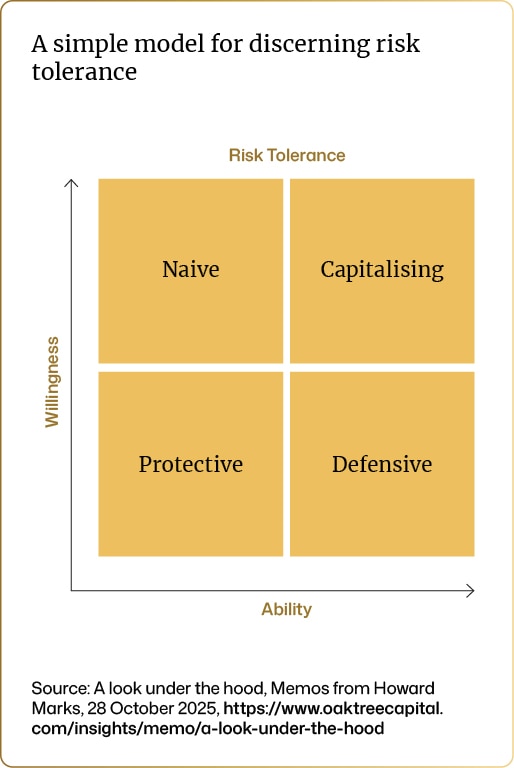
One axis considers an institution’s ability to bear risk. The other considers its willingness to bear risk. The model was developed in the context of a pension fund, yet it has obvious relevance for NFPs and endowments.
These organisations may not be paying pensions, but they are usually trying to do something just as serious: preserve capital, support a mission, fund activity over time and avoid becoming forced sellers when markets are unkind.
What risk can the organisation bear: threshold questions to work through
Ability to bear risk is the more financial of the two ideas. It asks what the organisation can withstand. How strong is its balance sheet? How reliable are donations, grants, fees, bequests or other sources of income?
How much of the organisation’s annual spending depends on the investment portfolio? Is the investment pool permanent, quasi-endowment capital, operating reserves, or money already earmarked for a known purpose?
How much liquidity is genuinely needed?
A large endowment supporting a modest annual draw is in a very different position from a small charity with uncertain cash flows and little room for error.
How much risk is the institution willing to stomach?
Willingness to bear risk is different. It is about temperament, trust and governance.
What level of loss, even temporary loss, could the board accept without changing course at a bad moment?
Would the organisation’s directors and decision makers be comfortable explaining a weak year to donors, beneficiaries, staff or members?
Is the organisation willing to lag its peers in a strong market if that is the price of a more resilient portfolio? Or would it feel pressure to chase returns if others appear to be doing better?
These are human questions as much as investment questions. Better to ask them in calm conditions than during a market fall.
The matrix gives boards four broad postures.
The high ability and high willingness combination is a capitalising position. It assumes that the organisation has the financial strength to take risk and the governance confidence to use that strength.
High ability but low willingness is defensive. The organisation could take more risk but chooses not to.
Combining low ability and low willingness is protective, which may be entirely sensible.
The combination of low ability and high willingness is the dangerous quadrant. Understandably, Marks calls it naive. It would be associated with an organisation that wants higher returns but may not survive the path required to pursue them.
Value of a risk tolerance model
For an NFP or endowment, the value of this model is not in the labels. It is in the conversation the labels provoke. A board might discover that it has more capacity for risk than it thought, because its spending needs are modest and its time horizon is long.
Another board might discover the opposite. Its capital may be described as long term, but the organisation’s annual programs depend heavily on it.
A third board might have a strong financial position but a culture that does not tolerate visible volatility. That is not necessarily wrong. But it should be named, because unnamed preferences tend to show up later as frustration with the investment strategy.
This is one reason an Outsourced Chief Investment Officer relationship should begin with risk appetite rather than product selection. A good investment partner can help make the conversation concrete. Not by asking, in the abstract, whether a board is conservative, balanced or growth-oriented.
Those words are too easy. Instead, the better discussion tests trade-offs.
What if the portfolio fell 10%? What if it fell 20%? What if a more defensive approach reduced the expected return and therefore the spending capacity over time?
What if diversification meant having some investments disappoint almost every year? What if avoiding illiquidity today meant giving up a source of return tomorrow?
These questions do not produce mathematical certainty. They produce alignment and alignment matters because risk appetite is not just a number in an investment policy statement. It is a compact between mission, money and behaviour. The portfolio should be capable of being lived with by the people responsible for it.
There is also a governance benefit. Once ability and willingness are discussed separately, boards can avoid confusing prudence with nervousness, or ambition with recklessness. A defensive posture may be exactly right for one organisation and unnecessarily cautious for another.
A more growth-oriented posture can be sensible where the ability to bear risk is strong and the board understands the journey. The point is not to push all NFPs and endowments towards higher risk. Quite the opposite. The point is to make sure the risk taken is deliberate, affordable and connected to purpose.
Only then should the discussion move to the usual investment toolkit — asset allocation, manager selection, liquidity, private markets, responsible investment preferences and performance reporting.
Those topics matter. But they are downstream. Risk appetite comes first because it tells the organisation what kind of investment journey it is prepared to take, and what kind it should probably avoid.
A simple matrix will not answer every investment question. No framework does.
But used properly, it helps a board ask the right first question. Not simply, what return do we want? A better question is this: what risks are we able and willing to carry in pursuit of the mission entrusted to us?
Important information
This communication is issued by MLC Asset Management Pty Limited ABN 44 106 427 472, AFSL 308953 ('MLC Asset Management', ‘we’), a member of the group of companies comprised Insignia Financial Ltd ABN 49 100 103 722 and its related bodies corporate (‘Insignia Group’). The Insignia Financial Group is ultimately controlled by CC Capital Partners LLC and its affiliates (a New York based private equity firm) and OneIM GP LLC and its affiliates (a London based private equity firm).
The information and commentary provided in this communication is of a general nature only and does not relate to any specific capability of, fund or product issued by an Insignia Financial Group entity. The information does not take into account any particular investor’s personal circumstances and reliance should not be placed by anyone on the information in this communication as the basis for making any investment decision. Before acting on the information, you should consider the appropriateness of it having regard to your personal or your organisation’s objectives, financial situation and needs.


