 5 min read |
 Geopolitical forces are a constant feature of markets. Recent developments — shifts in US trade policy, the gradual erosion of the rules-based international order, and conflict in the Middle East — can reasonably be viewed as business as usual.
Yet, the intensity of headlines and coverage, especially around the US and Israel v Iran clash, naturally triggers apprehension and uncertainty.
The safety of staying in cash or leaving money on the sidelines waiting for clarity before re-entering markets may appeal to some investors, at this time. While caution is emotionally understandable, the real challenge is what comes next.
Uncertainty heightens the risk of mistimed entry
Geopolitical shocks amplify behavioural biases. Loss aversion intensifies, recency bias dominates and waiting for certainty feels prudent. Markets, however, rarely wait for certainty.
Historically, equities tend to recover before geopolitical outcomes are resolved, rewarding those who stay the course (Chart 1).
Chart 1: Impact of world events on investment markets generally proves to be temporary
Past performance is not a reliable indicator of future performance.
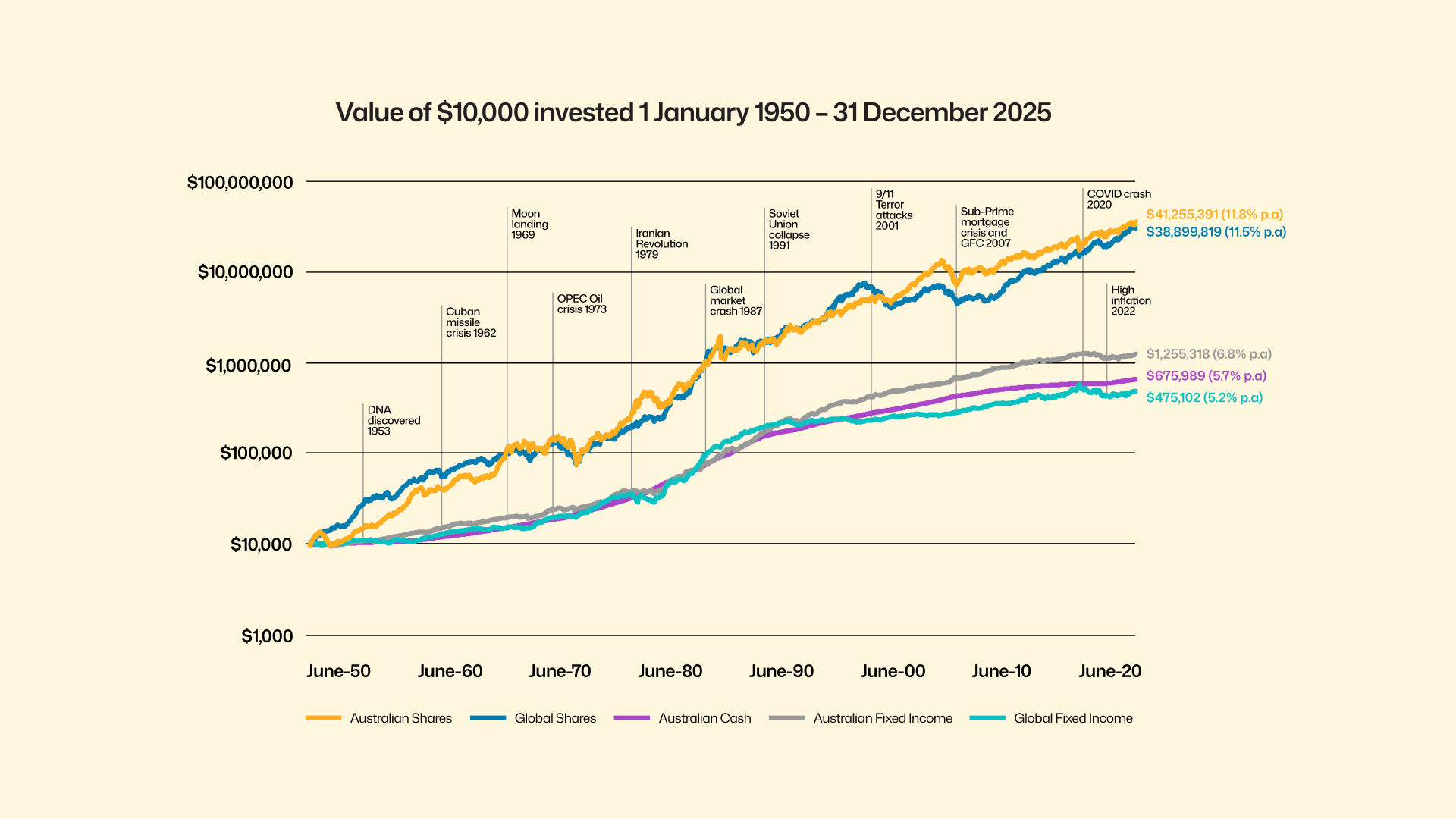
Source: Calculated by MLC Asset Management Services Limited based on investment market data (including reinvestment of income) from Global Financial Data, Inc. and FactSet. Returns and values for global fixed income and global shares are not hedged.
By the time risk feels comfortable, prices have often already moved higher. Investors who moved to cash during periods of stress face a second, more damaging decision: when to get back in.
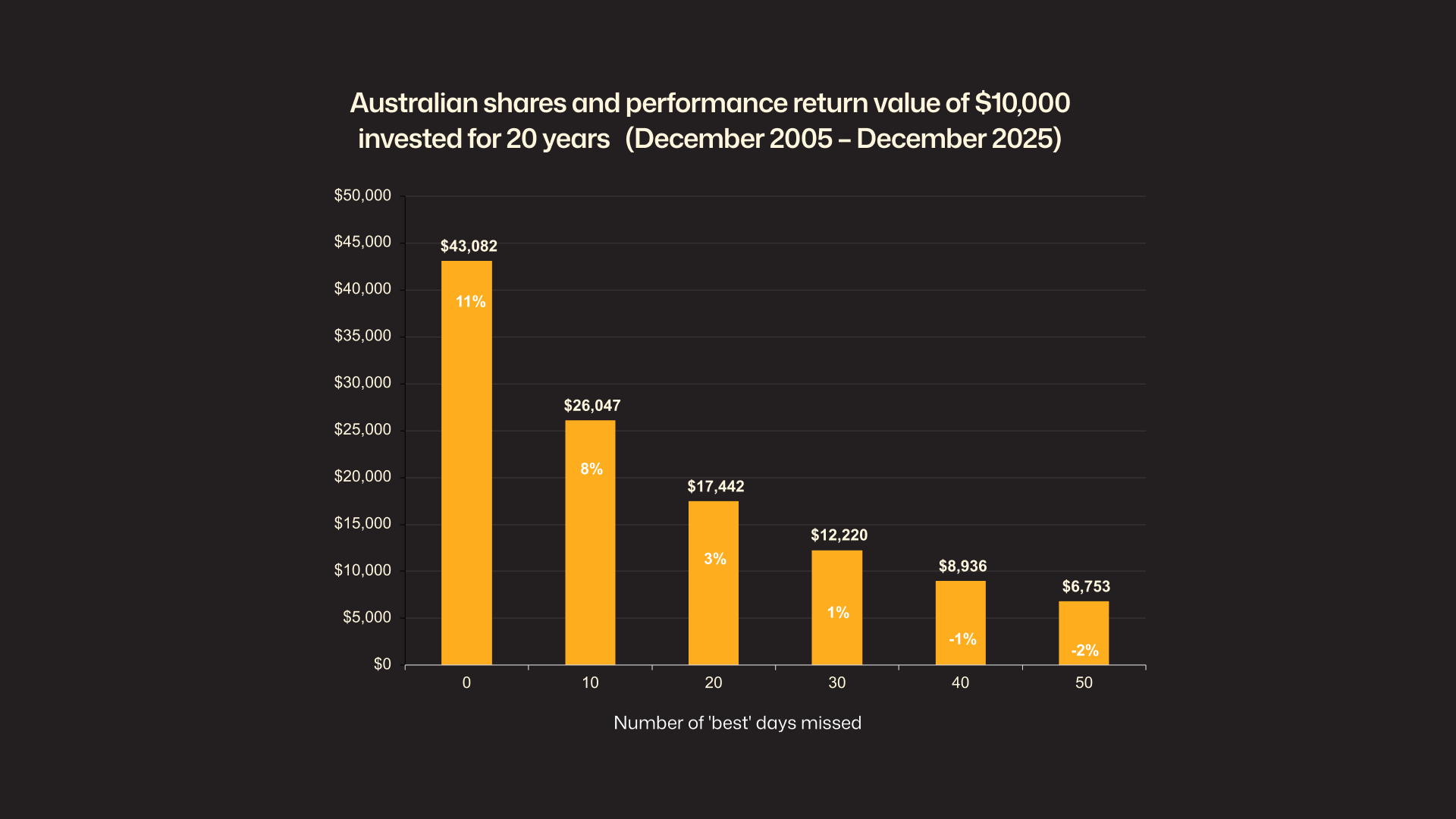
That decision is usually made too late; the proverbial horse has bolted. Missing just a handful of strong recovery days can materially reduce long-term returns (Chart 2). Geopolitical shocks don’t just create volatility; they increase the likelihood of permanent opportunity loss through poor timing.
Chart 2: Just days out of the market can be costly
Australian shares and performance return value of $10,000 invested for 20 years (December 2005 – December 2025)
Past performance is not a reliable indicator of future performance.
Source: Calculations by MLC Asset Management Services Limited. The 'market' is the Australian share market and is represented by the ASX All Ordinaries Total Return Index. Returns shown are an average annual return over 20 years.
.Market timing is, from our perspective, an unproductive pursuit that assumes perfect foresight. Even experienced investors struggle to do it successfully. Benjamin Graham, Warren Buffett’s mentor, captured this well remarking: “In the financial markets, hindsight is forever 20/20, but foresight is legally blind”.1
The corollary of Graham’s observation is that for most investors, market timing is a practical impossibility.
Cash feels comforting, but carries its own risks
Holding higher levels of cash during uncertainty provides psychological comfort. Yet prolonged time in cash introduces its own risks:
- Opportunity cost if markets rebound faster than expected
- Behavioural paralysis, difficulty reinvesting once conditions improve
- Inflation erosion, especially if uncertainty coincides with higher energy or commodity prices.
Ironically, environments that provoke investors to step away from markets are often those that reward disciplined participation over time.
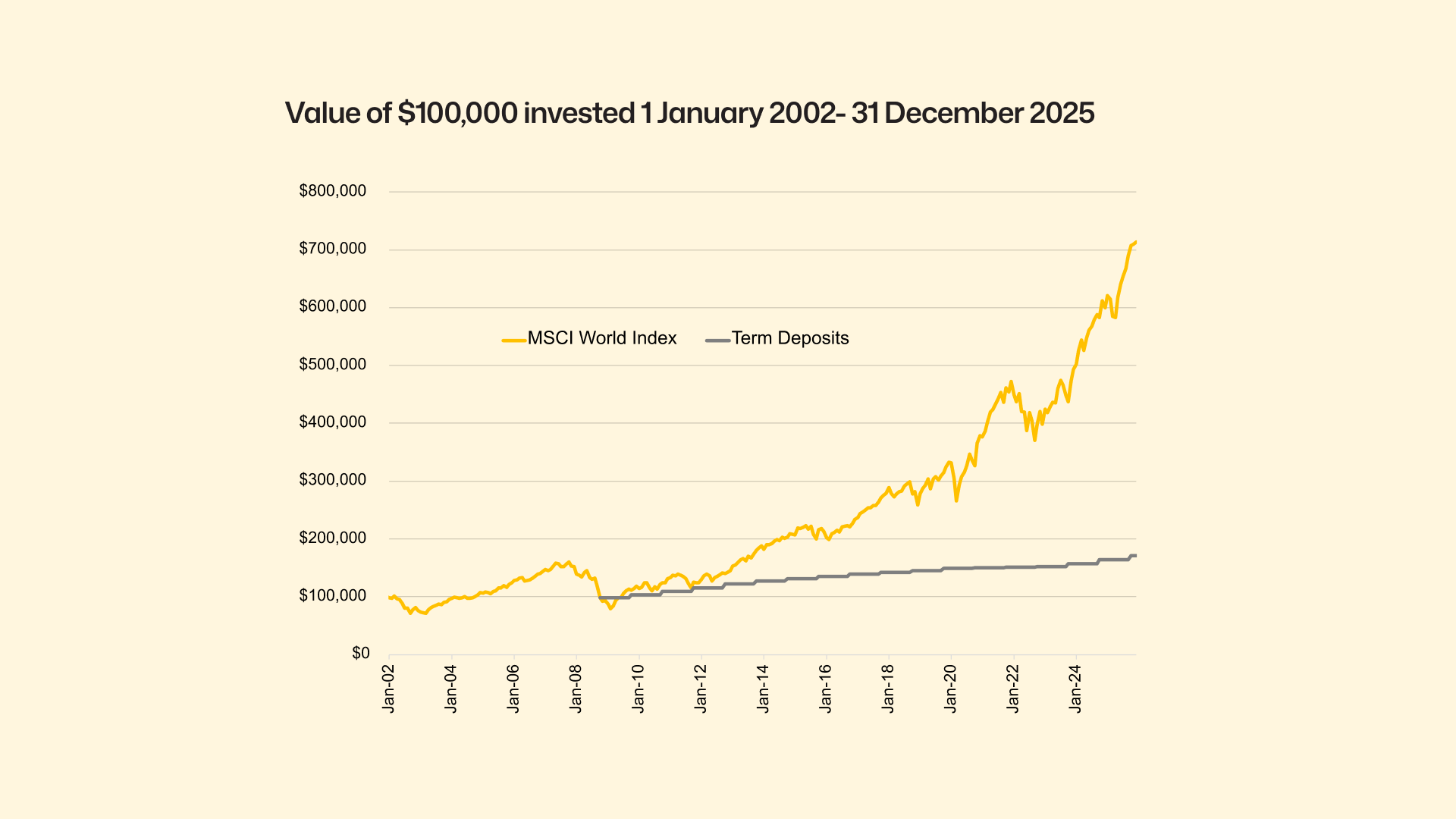
For example, an investor who remained in global equities after Lehman Brothers’ collapse in September 20082 and the eruption of the GFC would have seen their investment grow by more than fourfold compared to moving to term deposits (Chart 3).
This underscores the importance of discipline: staying invested through market declines rather than seeking temporary shelter in cash.
Chart 3: Even with the GFC impact, staying in global shares would have been far more rewarding that switching to term deposits
Past performance is not a reliable indicator of future performance.
Source: MLC Asset Management Services Limited, data updated to 31 December 2025. MSCI World Index ($A). Term deposits: 1 year bank’s term deposit ($100,000) – Reserve Bank of Australia.
Dollar cost averaging reframes the decision
This is where dollar cost averaging earns its place not as a return-enhancement strategy, but as a behavioural circuit breaker. It shifts focus from timing outcomes to process discipline.
Instead of asking, “Is now the right time to invest?”, the investor commits to regular, incremental participation regardless of headlines or short-term market direction.
In periods of geopolitical uncertainty, this reframing is powerful and:
- Reduces the emotional burden of re-entry by avoiding all-or-nothing decisions
- Lowers regret risk by deploying capital progressively
- Keeps capital engaged, reducing the chance of missing early recovery stages
Dollar cost averaging requires only confidence in the long-term rationale for owning growth assets, not in the outlook, which is often unavailable during geopolitical stress.
From market timing to behaviour management
The real value of dollar cost averaging lies in aligning investor behaviour with long-term objectives. Geopolitical shocks increase the temptation to wait, watch, and second-guess.
Dollar cost averaging provides a structured alternative, a way to respond to uncertainty without disengaging from markets. It allows investors to acknowledge risk without surrendering participation.
In this sense, dollar cost averaging is less about predicting the next move and more about protecting investors from their own instincts during periods of stress.
Important information
This communication is issued by MLC Asset Management Pty Limited ABN 44 106 427 472, AFSL 308953 ('MLC Asset Management', ‘we’), a member of the group of companies comprised Insignia Financial Ltd ABN 49 100 103 722 and its related bodies corporate (‘Insignia Group’). The information in this communication is intended for licensed financial advisers and other wholesale clients (as defined under the Corporations Act 2001 (Cth) in Australia.
The information and commentary provided in this communication is of a general nature only and does not relate to any specific fund or product issued by an Insignia Financial Group entity. The information does not take into account any particular investor’s personal circumstances and reliance should not be placed by anyone on the information in this communication as the basis for making any investment decision. Before acting on the information, you should consider the appropriateness of it having regard to your personal objectives, financial situation and needs.
Past performance is not a reliable indicator of future performance. The value of an investment may rise or fall with the changes in the market.
Any opinions expressed constitute our judgement at the time of issue and are subject to change without notice. We believe that the information contained in this communication is correct and that any estimates, opinions, conclusions or recommendations are reasonably held or made at the time of compilation. However, no warranty is made as to their accuracy or reliability or in respect of other information contained in this communication. Any projection or forward-looking statement in this communication is provided for information purposes only and no representation is made as to its accuracy or that it will be met.
This communication is directed to and prepared for Australian residents only.
Important information
This communication is issued by MLC Asset Management Pty Limited ABN 30 002 641 661 AFSL 308953 which is , part of the Insignia Financial group of companies comprising Insignia Financial Ltd ABN 49 100 103 722 and its related bodies corporate (Insignia Financial Group).
The information and commentary provided in this communication is of a general nature only and does not relate to any specific fund or product issued by an Insignia Financial Group entity. The information does not take into account any particular investor’s personal circumstances and reliance should not be placed by anyone on the information in this communication as the basis for making any investment decision. Before acting on the information, you should consider the appropriateness of it having regard to your personal objectives, financial situation and needs. You should consider the relevant Product Disclosure Statement (PDS) and Target Market Determination (TMD), available from the applicable Insignia Financial Group website or by calling us, before deciding to acquire or hold an interest in a financial product issued by an entity within the Insignia Financial Group.
Past performance is not a reliable indicator of future performance. The value of an investment may rise or fall with the changes in the market. Actual returns may vary from any target return described and there is a risk that the investment may achieve lower than expected returns.
No company in the Insignia Financial Group guarantees the repayment of capital or the performance of an investment, unless expressly stated in a PDS. Any investment is subject to investment risk, including possibly delays in repayment and loss of income and principal invested.
Any opinions expressed constitute our judgement at the time of issue and are subject to change without notice. We believe that the information contained in this communication is correct and that any estimates, opinions, conclusions or recommendations are reasonably held or made at the time of compilation. However, no warranty is made as to their accuracy or reliability or in respect of other information contained in this communication. Any projection or forward-looking statement (Projection) in this communication is provided for information purposes only. No representation is made as to the accuracy or reasonableness of any such Projection or that it will be met. Actual events may vary materially.
This communication is directed to and prepared for Australian residents only.


