June 2026 |  3 min read | Download PDF
John Gray, Head of Institutional Clients & Consultant Relations
CSO Series: Issue 3
When nonprofit organisations, endowment boards and investment committees appoint an Outsourced Chief Investment Officer (OCIO), the conversation naturally gravitates towards outcomes such as returns, risk management and resilience. Less visible, but just as important, is the ecosystem that sits behind those outcomes.
A well governed OCIO model is not defined by a single decision maker or star manager, but by a network of clearly defined roles, independent functions and disciplined processes that together support sound judgement and effective stewardship.
This ecosystem matters because complexity has become a permanent feature of institutional investing. Portfolios today span public and private markets, multiple liquidity profiles, and increasingly sophisticated risk exposures. This is a far cry from just a few generations ago when investing centred on combining Australian shares and government bonds.
No single individual, however experienced, can govern that complexity alone. Consequently, good governance is expressed not through hierarchy, but through constructive separation of responsibilities, informed challenges and escalation discipline.
At the centre of the ecosystem sits the investment team, typically organised by asset class — Australian and global shares, Australian and global fixed income, alternative assets, and private assets spanning private equity, real estate, and infrastructure.
Portfolio managers and analysts are responsible for research, portfolio construction, manager selection and ongoing monitoring. Their work blends top down insights with bottom up analysis, always within the constraints set by the client’s investment policy. Crucially, this team is focused on implementation and execution, not on defining the rules of the game itself.
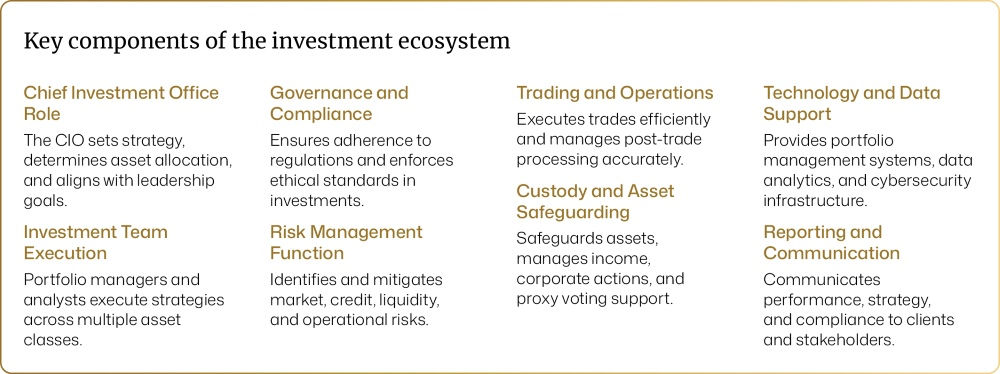
That separation matters, because sound governance depends on independence. A robust risk management function operates alongside, but separate from, investment teams. Its role is to identify, measure and monitor risks across the portfolio — market, liquidity and operational.
Scenario analysis and stress testing provide an independent check on portfolio construction, ensuring that risk remains aligned with agreed tolerances and that any emerging concentrations are visible before they become embedded.
Supporting both is a strong governance and compliance framework. This function ensures investment activity adheres to regulatory obligations, internal policies and ethical standards. It oversees guideline compliance, monitors conflicts of interest, and enforces escalation when boundaries are tested. Well-designed compliance is not about slowing decisions or adding bureaucracy; it is about ensuring decisions are made on a sound, transparent and defensible footing.
Execution, too, plays an essential role. A dedicated trading function is responsible for implementing portfolio decisions efficiently and cost effectively. Traders monitor market conditions in real time, manage liquidity, and seek best execution across instruments and geographies. This function provides a practical governance check, ensuring that investment intent is translated into outcomes without unnecessary friction, hidden costs or operational risk.
Once trades are executed, the operations function takes over managing settlement, reconciliation, corporate actions and data integrity across systems. Closely linked is the custody function, which safeguards assets, collects income, processes corporate actions and supports audit and reporting requirements. These functions often receive little attention when they work well, but history shows that weaknesses here can undermine even the strongest investment strategy.
Underpinning the entire ecosystem is technology and data management. Portfolio management systems, analytics platforms, cybersecurity frameworks and Environmental, Social, and Governance (ESG) data integration enable scalability, transparency and consistency. Technology does more than improve efficiency; it enables oversight allowing governance principles to be observed, tested and reinforced in real time rather than assumed.
Finally, client reporting brings the ecosystem together. Effective reporting is not a theatrical recital of past returns, but a structured account of decisions, risks and trade offs. It provides context, explains outcomes and highlights what has changed. For boards and investment committees, this reporting supports informed oversight without drawing them back into day to day management.
Taken together, these components form the practical expression of governance in an outsourced CIO model. No single function guarantees success, and no structure eliminates risk. But when roles are clearly defined, independence is preserved and processes reinforce one another, the result is an ecosystem designed not merely to manage capital, but to steward it with discipline, transparency and care, over time.
Important information
This communication is issued by MLC Asset Management Pty Limited ABN 44 106 427 472, AFSL 308953 ('MLC Asset Management', ‘we’), a member of the group of companies comprised Insignia Financial Ltd ABN 49 100 103 722 and its related bodies corporate (‘Insignia Group’). The Insignia Financial Group is ultimately controlled by CC Capital Partners LLC and its affiliates (a New York based private equity firm) and OneIM GP LLC and its affiliates (a London based private equity firm).
The information and commentary provided in this communication is of a general nature only and does not relate to any specific capability of, fund or product issued by an Insignia Financial Group entity. The information does not take into account any particular investor’s personal circumstances and reliance should not be placed by anyone on the information in this communication as the basis for making any investment decision. Before acting on the information, you should consider the appropriateness of it having regard to your personal or your organisation’s objectives, financial situation and needs.


