 8 min read |
Inflation does not retire when investors do.
As investors approach or enter retirement, their priorities likely change with the focus shifting from building wealth to one that emphasises preserving what their accumulated wealth can buy.
That’s why the breadth of investments we offer stands in stark contrast to a ‘one size fits all’ approach.
After decades of saving, many investors become less focused on chasing the highest possible return. The question becomes: how do they protect what they've built while ensuring their money continues to work for them?
Investors need to manage both risks. In our view, successful investing is not just about capturing gains in rising markets. Limiting losses during market downturns1 is equally important.
Investors also need to be mindful of inflation. While drawdowns can damage portfolios quickly, inflation works more quietly, and over time can erode the purchasing power of savings and income.
Recognising these challenges, we developed the MLC Real Return portfolios.2
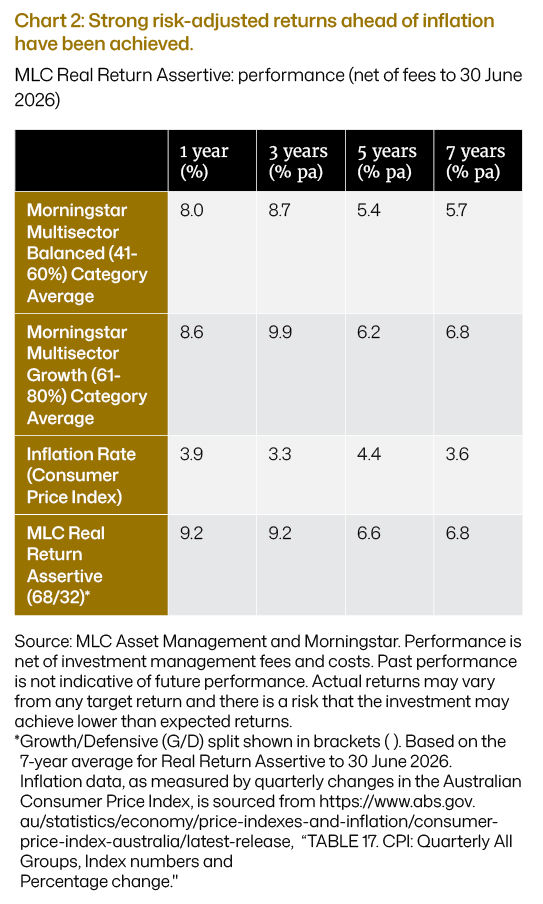
Performance over the past seven years3 shows these portfolios have generated returns above inflation while limiting the risk of negative returns.
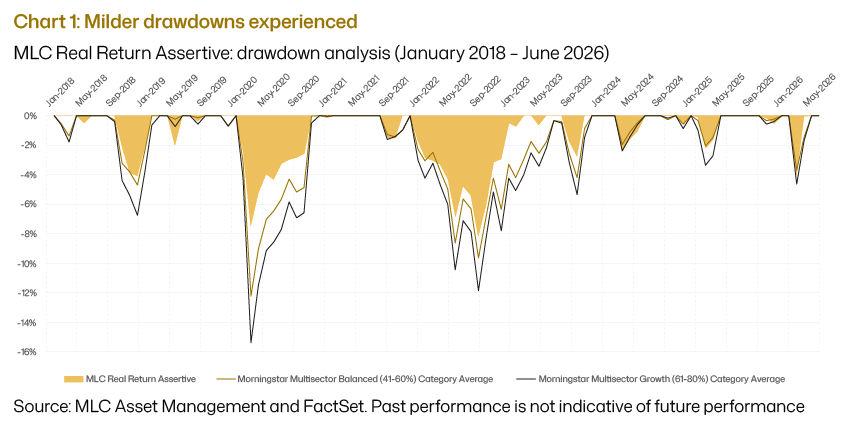
The MLC Real Return Assertive portfolio’s performance during periods of market stress supports this, with the portfolio generally experiencing less severe drawdowns than funds with similar or lower allocations to growth assets.
This is evidenced in Chart 1 with MLC Real Return Assertive often outperforming during market downturns against the Morningstar Multisector Balanced and Growth fund peer universes. These peer groups typically comprise funds with fewer asset allocation levers than the MLC Real Return funds, which are characterised by a high degree of asset allocation flexibility —- both via a dynamic asset allocation approach as well as wide investible asset class ranges.
Importantly, this downside protection has not come at the expense of long-term returns. Over the seven years to 30 June 2026, the MLC Real Return Assertive portfolio delivered returns broadly in line with the Morningstar Multisector Growth Category Average, and meaningfully ahead of the inflation rate (Chart 2).
In other words, the portfolio has delivered growth-fund-like returns with balanced-fund-like risk (Charts 1 and 2). The result has been strong risk-adjusted returns for investors seeking to protect the wealth they have built while keeping their money working for them.
Markets fall more often than might be assumed
Investment professionals live in a world of comparative returns. Performance tables, benchmarks and rankings create a steady drumbeat, and the top-line number can begin to look like the only number that matters.
But investors don't experience returns as percentages on a page. They experience them through the journey. If an investment falls 50% in value, it must rise 100% simply to recover.
Long-running bull markets have a habit of making risk feel distant. The COVID sell-off of 2020 and the inflation-driven bear market of 2022 were blunt reminders that strong long-term markets can still be interrupted by sudden, severe volatility.
For investors approaching retirement, or already drawing on their savings, limiting the damage through those periods may matter as much as participating in rising markets. Losses early in retirement can be particularly difficult to recover from when withdrawals continue.
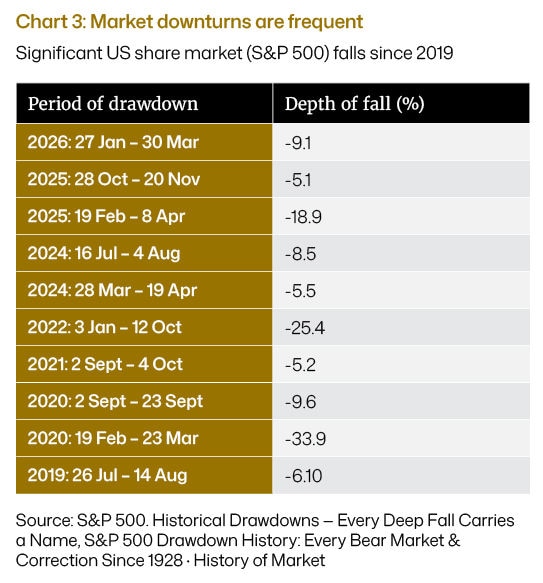
Those episodes stand out, but drawdowns are not unusual (Chart 3). Since 1928, the S&P 500 Index has recorded 73 “qualifying drawdowns”,4 including 12 bear markets, defined as falls of 20% or more.5
Put another way, across almost a century, the world’s most closely watched sharemarket index has fallen by at least 5% in most years. While the next setback cannot be timed with confidence, portfolios can still be built with it in mind.
How inflation silently chips away at wealth
The inflation surge of recent years made the damage caused by rising prices hard to miss. Yet inflation does not need to be spectacular to be corrosive. Even the Reserve Bank of Australia’s 2–3% target range can steadily erode wealth.
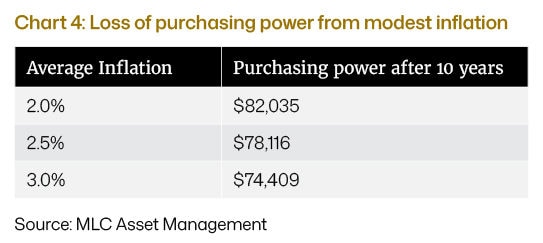
Consider $100,000 earning no return for 10 years. The account balance may not change, but what that money can buy certainly does.
At annual inflation of 2–3%, the statement balance would still read $100,000, but its purchasing power would fall to roughly $82,000–$74,000 in today’s money (Chart 4). Between one-fifth and one-quarter of its real value would be gone.
That is a strong case for treating real returns as an ‘always-on’ concern, particularly for investors approaching or living in retirement.
How we address the twin threats of drawdowns and inflation
The problem is plain enough. The harder question is how to pursue returns above inflation without leaving a portfolio overly exposed when markets fall.
The first lever is flexibility. Unlike a traditional balanced fund anchored to a strategic asset allocation, the MLC Real Return portfolios can move across wider growth and defensive ranges and adjust individual asset-class exposures as risks and opportunities change. This gives our portfolio managers more room to reduce dependence on expensive or vulnerable markets, or to add risk when prospective returns improve.
The second is genuine diversification. The portfolios invest in return streams that are not tightly tied to shares, bonds or property. These include insurance-related investments as well as opportunistic capital solutions, which can invest across public and private markets and are currently focused mainly on niche, often collateral-backed credit.
Used alongside tailored shares and derivatives, these strategies widen the sources of return and provide tools to manage downside risk. No single holding does the job. Together, greater allocation freedom and differentiated return drivers give the portfolios a better platform for pursuing purchasing power while seeking to limit large losses.
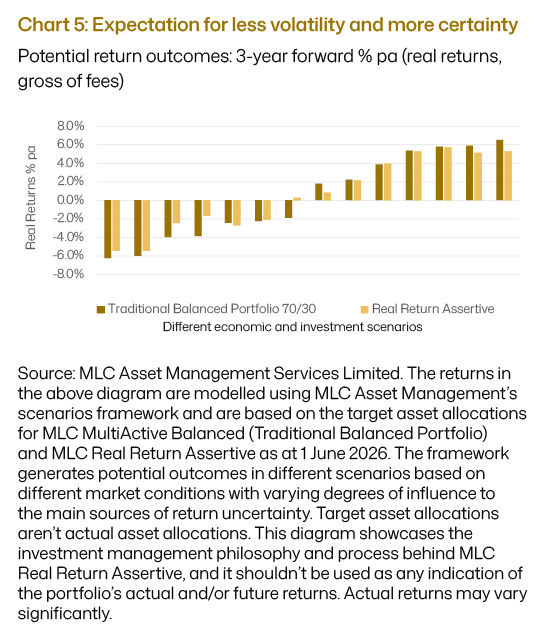
The historical results for the MLC Real Return Assertive portfolio are shown in chart 2. Looking ahead, MLC’s scenario analysis indicates that Real Return Assertive is expected to produce a narrower range of outcomes than a traditional balanced portfolio across a variety of market environments (Chart 5).
These are modelled expectations, not promises. However, they illustrate what the portfolio is designed to do: pursue worthwhile real returns with less reliance on any single market outcome.
Success is not simply about achieving growth. It's also about maintaining purchasing power, navigating market setbacks and helping savings continue to support the lifestyle investors worked hard to build.
Discover more about MLC Real Return.
1 A drawdown measures the fall from a market peak to the subsequent trough
2 MLC Real Return portfolios referenced in this article are — MLC Real Return Assertive, and MLC Real Return Moderate
3 See https://www.mlcam.com.au/our-investment-managers/mlc/resources/flyers for performance details for the MLC Real Return portfolios
4 “Qualifying drawdown” in this context means market declines of 5% or more from a previous peak. S&P 500. Historical Drawdowns — Every Deep Fall Carries a Name, S&P 500 Drawdown History: Every Bear Market & Correction Since 1928 · History of Market
5 Ibid
Important information
This communication is issued by MLC Investments Limited ABN 30 002 641 661 AFSL 230705 in its capacity as responsible entity and trustee of MLC Real Return Moderate and MLC Real Return Assertive. MLC Investments Limited is part of the Insignia Financial group of companies comprising Insignia Financial Ltd ABN 49 100 103 722 and its related bodies corporate (Insignia Financial Group).
The information and commentary provided in this communication is of a general nature only and does not take into account any particular investor’s personal circumstances and reliance should not be placed by anyone on the information in this communication as the basis for making any investment decision. Before acting on the information, you should consider the appropriateness of it having regard to your personal objectives, financial situation and needs. All investments come with risks. Investments in MLC Real Return Moderate and MLC Real Return Assertive come with risks of negative returns, capital loss, income fluctuations and market-related volatility. You should consider the relevant Product Disclosure Statement (PDS) and Target Market Determination (TMD), available from mlcam.com.au/mlctrusts/pds and mlcam.com.au/TMD or by calling us on 1300 738 355, before deciding to acquire or hold an interest in a MLC Real Return portfolio.
Past performance is not a reliable indicator of future performance. The value of an investment may rise or fall with the changes in the market. Actual returns may vary from any target return described and there is a risk that the investment may achieve lower than expected returns.
No company in the Insignia Financial Group guarantees the repayment of capital or the performance of an investment, unless expressly stated in a PDS. Any investment is subject to investment risk, including possibly delays in repayment and loss of income and principal invested.
Any opinions expressed constitute our judgement at the time of issue and are subject to change without notice. We believe that the information contained in this communication is correct and that any estimates, opinions, conclusions or recommendations are reasonably held or made at the time of compilation. However, no warranty is made as to their accuracy or reliability or in respect of other information contained in this communication. Any projection or forward-looking statement (Projection) in this communication is provided for information purposes only. No representation is made as to the accuracy of any such Projection or that it will be met. Actual events may vary materially.
This communication is directed to and prepared for Australian residents only.


